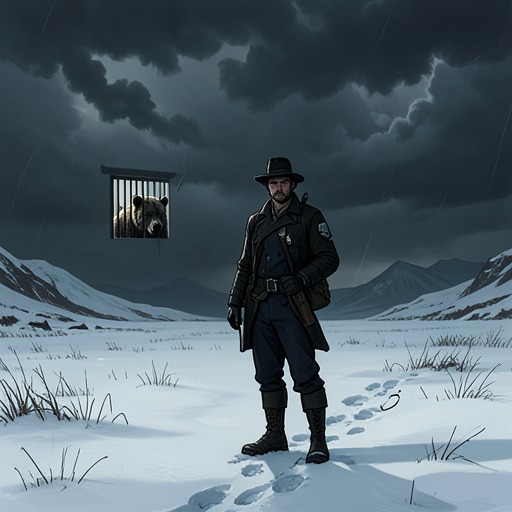
Patrick Sumner—Henry Drax
The North WaterPatrick Sumner and Henry Drax move from uneasy proximity aboard a whaling ship to a conflict that ends with Sumner killing Drax. Their relationship develops against the expedition’s brutal commercial routine: Drax is a relentless hunter, while Sumner, the ship’s surgeon, is drawn into physical labor alongside the crew. Later, the concealed business surrounding the Volunteer gives their antagonism a further dimension, as Sumner connects Drax to a failed plan involving the ship’s sinking. In the aftermath, Sumner must decide whether to pursue the man he believes may still be alive; he eventually tells Baxter that the question has been settled by his own hand.
Shipmates in the Whaling Trade
The two men share the northbound voyage and the work of the sealing and whaling seasons, but the evidence presents them in sharply different circumstances. During the passage north from Lerwick, Sumner is incapacitated by seasickness while the ship crosses fog, sleet, and gales. Drax, by contrast, appears on the ice as a practiced and tireless hunter. He works alone across the seal pack, killing seals and removing their skins while the five whaleboats fill with their catch. Brownlee counts the skins and calculates their prospective value, making plain the commercial purpose of the labor in which Drax excels.
Their positions remain distinct when the expedition turns to whales. After a whale is brought alongside, Brownlee estimates its oil and whalebone at nearly nine hundred pounds. The carcass is processed by other crewmen, while Sumner later receives a pick haak and leather apron and is assigned to carry blocks of blubber from the foredeck down into the hold. He slips repeatedly and is saved from falling into the hold by Otto. Though bruised and exhausted, he takes satisfaction in the work and sleeps without laudanum for once. Cavendish jokes that the surgeon may yet become a whale man. The episode does not show Drax and Sumner working as partners; instead, it places them within the same system of dangerous labor, with Drax established in hunting and Sumner temporarily brought into the physical work that sustains the voyage.
From Proximity to Pursuit
The later relationship is defined less by ordinary shipboard contact than by Sumner’s knowledge of violence and his uncertainty about what has become of Drax. When Baxter urges him to leave Drax behind, Sumner does not answer at first. He then says that someone should search for Drax and considers trying himself, since Drax might still be alive. Baxter responds that Drax is either dead or in Canada and argues that a surgeon has no business pursuing murderers. He presents forgetting the past as the wiser course and predicts that Drax will be judged in time.
Sumner does not accept that reassurance outright. He says that if he ever sees Drax again, he expects to know what to do. Baxter insists that such a meeting will not happen and that Drax is gone for good. The exchange leaves Sumner’s intention unsettled: he has not yet disclosed the outcome, and his words could be heard as a readiness to act if Drax reappears. His later admission changes the meaning of that earlier uncertainty. The pursuit Baxter tells him to abandon has already ended in a killing.
The Volunteer and the Disputed Plot
Sumner’s account of Drax’s place in the events surrounding the Volunteer appears in a conversation with Baxter, who has urged silence about the deaths on the voyage. Sumner rejects the idea that everything was an accident, reminding Baxter that he has read Sumner’s letter and knows about the killings. When the discussion turns to the ship, Sumner accuses Baxter of having Cavendish sink the Volunteer, on the ground that Drax and Sumner were the only men who might have known or guessed what had happened.
Sumner describes a planned sequence in which Drax would shoot him and Stevens would then shoot Drax, leaving the matter apparently resolved. He says that the plan misfired. This is Sumner’s accusation to Baxter, not an uncontested account: Baxter denies that Sumner’s explanation is right and counters that two men lie dead in the timber yard, one murdered by Sumner. The exchange ties Sumner and Drax together through more than personal hostility. In Sumner’s version, they are both potential witnesses to a concealed act involving the ship; in Baxter’s response, Sumner’s own actions have made him vulnerable to legal and personal consequences.
Death and Aftermath
Baxter asks what became of Drax, and Sumner answers that he killed him. He also identifies Stevens as the man shot in the back of the head and confirms that Drax was responsible. Sumner gives no further account of how he killed Drax in this conversation. When Baxter remarks on his boldness, Sumner explains that the choice had been between one man and the other. The statement establishes the confrontation’s lethal outcome without presenting it as a victory or offering a fuller description of the encounter.
This revelation closes the gap between Sumner’s earlier possibility that Drax might still be alive and Baxter’s insistence that he should put Drax behind him. Sumner had appeared to be considering a search; by the time he speaks with Baxter, Drax is dead by his hand. Their relationship therefore ends not with reconciliation, judgment by an outside authority, or a settled public account, but with Sumner’s brief admission and Baxter’s recognition of its consequence. Drax’s death resolves the immediate question of whether Sumner will see him again, while leaving the circumstances and responsibility surrounding the Volunteer contested in their conversation.